The Church of England is currently carrying out a navel-gazing operation to see whether any of its funds from Queen Anne’s Bounty were gained from slave trading carried out by the South Sea Company, in which Queen Anne had a major stake. The Bounty originated around 1704 amid concern about the growth of non-conformism and the poor incomes of many of the minor clergy such as curates. Essentially it diverted the income to the Crown from the “first fruits and tenths” of ministeries into a fund and redistributed this to poorer clergy. This was done by lottery, the chosen being typically granted £200 to buy property whose rents augmented their income. This system was incorporated into the Church Commissioners as late as 1948. Here is a typical example from 1719/1720, courtesy of my cousin Val Slater.
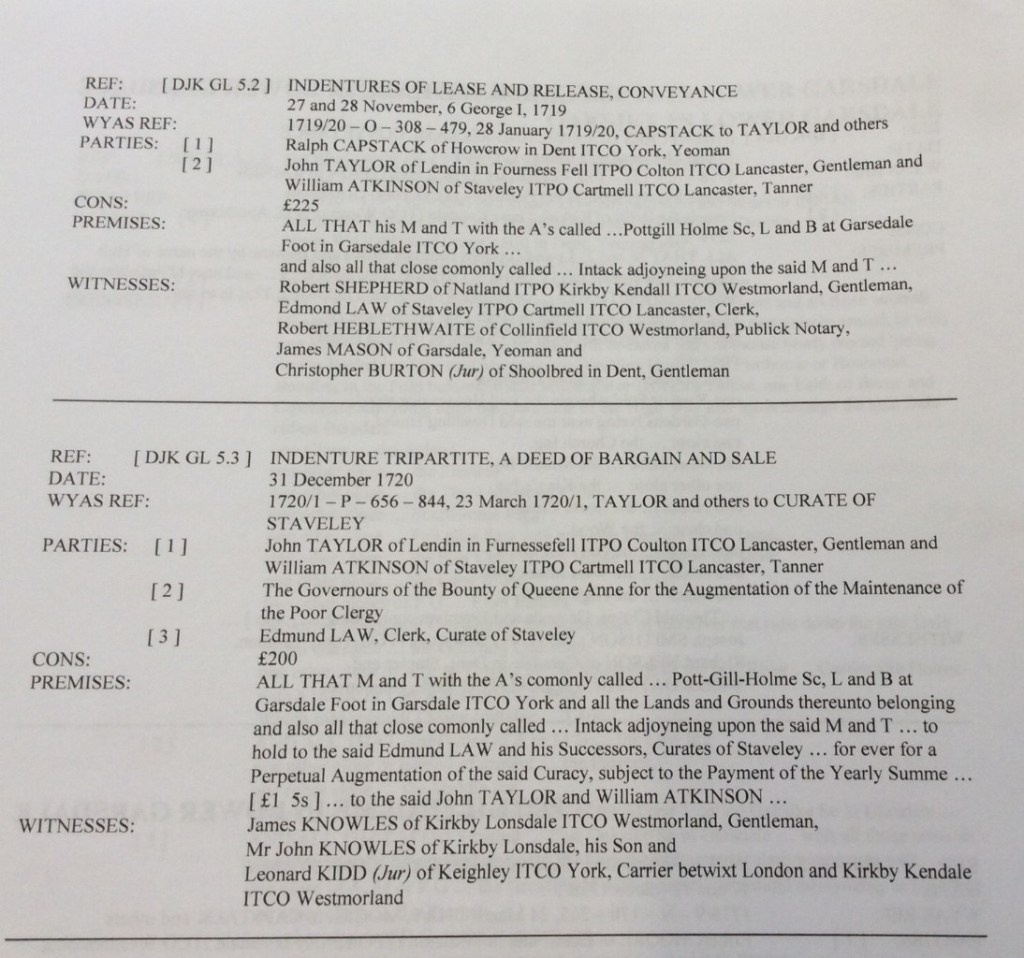
These transactions show that Ralph Capstack, a yeoman in Dent, Yorkshire sold Pot Gill Holme in Garsdale for £225 to John Taylor and William Atkinson near Cartmel. They then sold it for £200 to be held by the local curate Edmund Law. From the rent £1 5s would go to Taylor and Atkinson each year to compensate their £25 loss and the remainder to the curate and his successors in perpetuity. As with most subsidies I suspect the price was probably inflated a little. Edmund Law remained as curate of Stavely until 1740.
There is a certain irony in this example in that the “poor” Edmund Law’s son became the Bishop of Carlisle, whose extremely wealthy sons included the 1st Lord Ellenborough. A little investment certainly goes a long way. I came across this transaction while trying to find a connection between my 5th great grandfather Henry Law (1699-1775) and the Barons of Ellenborough. Henry’s youngest son Rev James Law (1755-1831) was reputed to “be descended from the same stock which produced the noble family of Ellenborough”.
Henry Law was a yeoman hill farmer born in Weasdale, Ravenstonedale. Sometime before 1727 he married his first wife Isabel and moved to Garsdale. Isabel died in 1742. In 1754 he settled his main residence, Rantree, on his eldest son John and married again to Dorothy Watson. Then he moved into the property Pot Gill Holme mentioned above, renting it from the curate of Stavely. His will of 1769 settled other properties that he owned around Sedbergh in trust to provide an income to Dorothy for life’ and thereafter to pass into the possession of James. She survived him until 1798.
Pot Gill Holme is now a derelict grade II listed building in danger of serious decay. It is very close to 3 properties known to have been owned by Henry’s eldest son John. I do wonder how it came to the attention of Edmund Law to acquire it in the first place, being 33 miles away. There is no concrete evidence here of a connection with the Barons of Ellenborough, but Edmund Law’s father was a yeoman farmer at Carhullan, Bampton, less than a mile away from where my grandmother Margaret Law was born to hill farming parents.
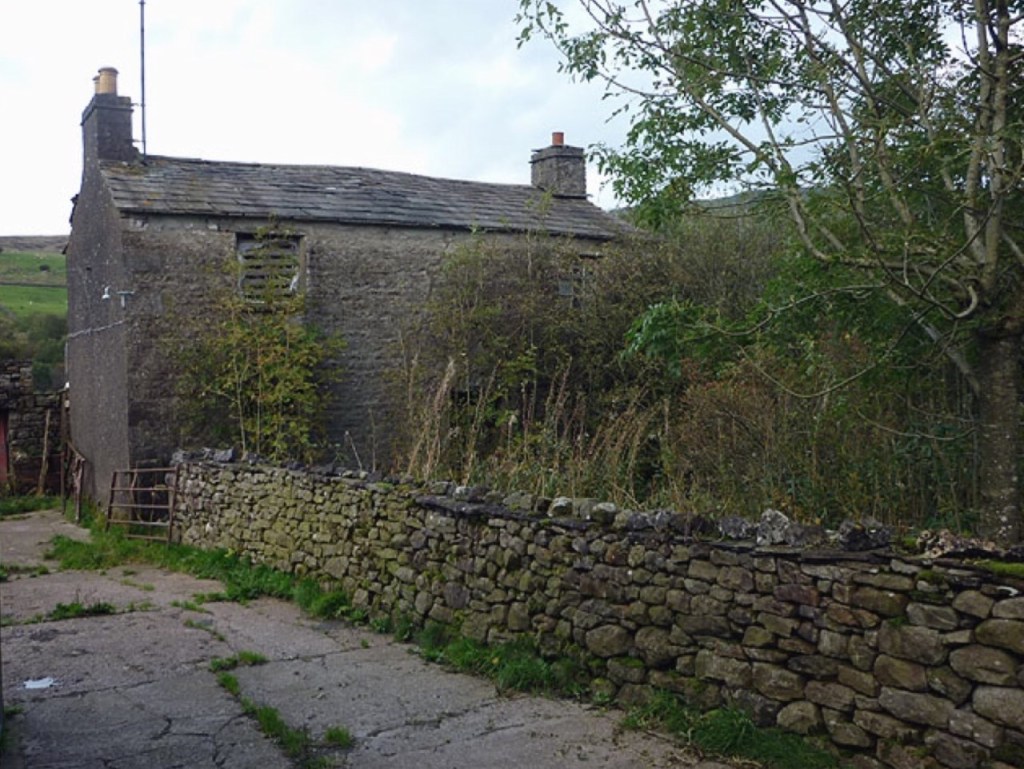
Pot Gill Holme, Garsdale. Photo courtesy of Val Slater
 Chronicles